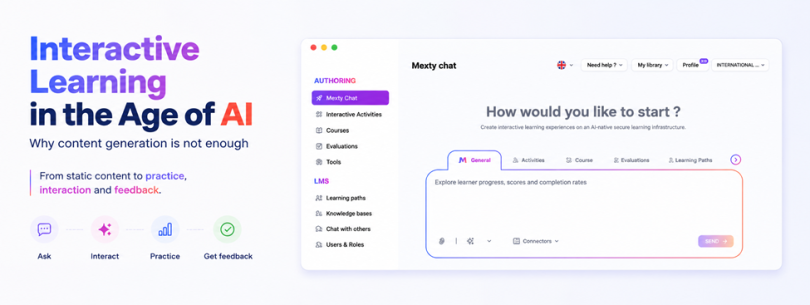

Artificial intelligence has made educational content easier to create than ever before.
Teachers can generate lesson plans, summaries, quizzes, worksheets and explanations in seconds. That can save time, but it also creates a new question: does producing more content actually improve learning?
Not necessarily.
Students do not learn simply because information is available. They learn when they have to retrieve knowledge, make decisions, solve problems, receive feedback and try again.
That is why interactive learning matters even more in the age of AI.
From content generation to active practice
The first wave of educational AI has focused heavily on generation.
A teacher asks for ten questions about a topic, and AI produces them. A PDF becomes a summary. A lesson outline becomes a presentation.
Useful, certainly. But the bigger opportunity is to use AI to create practice, not just content.
Imagine a science lesson where students predict the outcome of an experiment before seeing the explanation. A history lesson where they make decisions inside a scenario. A vocabulary activity where they classify, match and reuse words in different contexts. Or a professional skills lesson where they practise responding to realistic situations.
The learning experience moves from:
Read → Watch → Answer
to:
Explore → Decide → Practise → Receive feedback → Try again
That shift matters because students are no longer simply consuming information. They are doing something with it.
Interactivity does not have to mean technical complexity
Historically, creating sophisticated interactive learning could require specialist software, instructional design expertise or even programming skills.
AI is lowering that barrier.
New tools allow educators to describe the learning experience they want and then generate a first version that can be refined.
An AI lesson creator for teachers, for example, can help transform existing lessons, presentations, documents or ideas into quizzes, branching scenarios, simulations and interactive activities.
This makes it increasingly possible to create interactive courses without coding.
The teacher does not need to become a developer. The technology handles more of the production work, while the teacher focuses on the pedagogical decisions.
Existing materials become more valuable
AI does not mean teachers have to throw away years of work.
Quite the opposite.
A trusted worksheet, presentation or lesson can become the starting point for several different learning experiences.
A single source might be transformed into:
- an interactive quiz;
- a matching or classification activity;
- a scenario;
- a simulation;
- a formative assessment;
- a game or challenge;
- a complete interactive lesson.
Platforms such as Mexty are built around this idea. Mexty is an AI-native platform for creating interactive learning experiences that allows teachers to start from an idea or existing material and create editable activities, assessments, scenarios and courses.
The goal is not simply to automate course production. It is to make richer forms of learning easier to create.
The teacher still makes the important decisions
AI can generate quickly, but it does not automatically know what a particular group of students needs.
Teachers still need to decide:
What is the learning objective?
What should students practise?
Where are they likely to struggle?
What kind of feedback will help?
Which information is accurate and appropriate?
That is why human review remains essential.
The strongest educational AI workflows keep teachers in control. Generated content should be editable, reviewable and adaptable before students see it.
This is particularly important as schools begin evaluating not only what AI can create, but how securely and responsibly it does so.
A secure educational AI platform should support privacy, trusted source material, human oversight and clear control over final content.
AI should make better learning easier to build
The most important promise of AI in education may not be that teachers can create ten times more material.
It may be that they can create forms of learning that previously required too much time or technical effort.
An Interactive Learning Platform can help teachers move beyond static content and create more opportunities for students to think, practise, receive feedback and improve.
That is a more meaningful measure of progress than the number of lessons generated.
AI has already made educational content abundant.
The next challenge is making that content worth learning from.