Every teacher knows the moment: the exam papers come back revealing that half the class misunderstood something taught six weeks ago — and misunderstood it confidently, in the same way, the whole time. The information needed to fix it existed in week one. Nobody collected it. Formative assessment is the practice of collecting it: small, frequent, low-stakes checks for understanding during learning, used to adjust teaching while adjustment is still cheap. It is less a technique than a posture — teach, check, respond, repeat — and the research behind it ranks among the strongest effects in education.
Formative vs Summative: Steering vs Autopsy
Summative assessment — the exam, the final grade — measures learning after the fact and mostly serves reporting. Formative assessment happens during learning and serves learning itself: its results change what the teacher does next and what the student practises next. The classic analogy is a cook tasting the soup versus the guests tasting it; only one of them can still add salt. A useful formative check has three properties: it is quick (minutes, not a lesson), it reveals thinking rather than just answers, and its results are acted on visibly — otherwise students learn the checks are theatre and stop taking them seriously.
Five Checks That Take Under Five Minutes
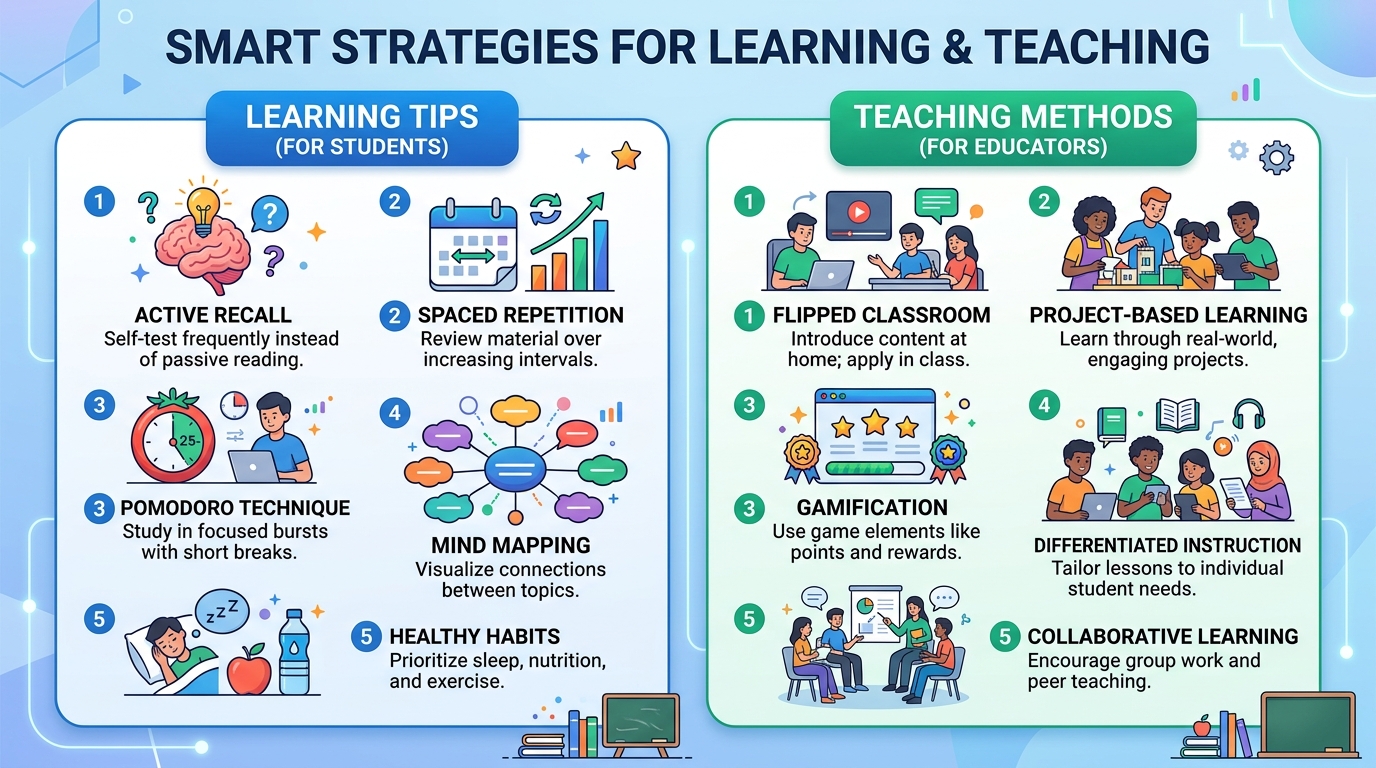
The exit ticket: in the last three minutes, students write the answer to one pointed question (“What is the difference between X and Y?”) plus one thing still unclear; sorting the pile into got-it / nearly / lost takes minutes and plans tomorrow’s first ten. Hinge questions: a multiple-choice question mid-lesson where each wrong option maps to a specific misconception, answered by the whole class at once (fingers, cards, a quick poll) — the lesson branches on the result. Think-pair-share with cold-calling, which forces retrieval from everyone rather than the three volunteers. The one-minute paper after a concept: “Explain it to a ten-year-old” — vagueness becomes instantly visible. And worked-example error hunts: present a solution containing a planted mistake and ask students to find and fix it, which surfaces misconceptions that correct answers conceal. These pair naturally with the engagement methods in our guide to active learning strategies — activity generates the thinking, formative checks make it visible.
Designing Questions That Reveal Thinking
A formative question earns its minutes when wrong answers are informative. Build distractors from the misconceptions you know are coming: if students habitually confuse correlation with causation, one option should be the correlation answer, so choosing it names the exact repair needed. Ask for reasons, not only results — a correct answer with a wrong reason is a debt that comes due at the exam. Mix recall with transfer: one question on today’s definition, one applying it to a case not shown in class. And vary the format across the week (write, vote, discuss, draw the process) so the check measures understanding rather than skill at one question style.
Feedback That Students Actually Use
Formative data fails at the last metre when feedback arrives as a grade and a tick. Grades attached to formative work suppress the information — students compare numbers and ignore comments. Keep formative work ungraded or completion-only, and make feedback specific, short and forward-pointing: what was right, the one thing to fix, and where to practise it. Then protect time to use it — five minutes at the next lesson’s start for students to act on the comment converts feedback from reading material into learning. Self- and peer-assessment against a clear model answer extend the same loop without extending the teacher’s marking pile, and judging others’ work against criteria is itself a powerful way to internalise them.
Closing the Loop: What Changes Tomorrow
The assessment is only formative if something changes. Keep the responses brutally practical: reteach the point a different way when a third of the class missed it (repeating the same explanation louder is not a strategy), form a quick small group for the nearly-there students while the secure ones extend, and move on without guilt when the checks say the class is ready. Record patterns in a sentence or two per lesson — the log becomes next term’s planning gold, revealing which topics reliably trip students and which checks reliably catch it. Over a term, this loop compounds into something students can feel: lessons that seem to anticipate their confusion, because they do.
Technology’s Role — Servant, Not Driver
Quiz apps, polling tools and auto-marked question banks genuinely help: they collect whole-class responses instantly, tally the hinge question in seconds, and store the pattern over time so trends are visible. Used well, they remove the clerical cost that used to make frequent checking impractical. Used badly, they narrow assessment to whatever is auto-markable — recall trivia with pretty leaderboards, while the deeper checks (explain, justify, find the error) quietly disappear. The rule that keeps technology in its place: choose the question the learning needs first, then pick the cheapest tool that delivers it — which is sometimes an app, and sometimes thirty scrap-paper exit tickets that took ninety seconds to read.
Starting Small: The First Two Weeks
Do not rebuild your whole practice in a weekend. Week one: add one exit ticket per lesson, and actually sort it — the habit of looking is the foundation everything else stands on. Week two: add one hinge question at the natural mid-point of each lesson, with distractors built from the misconceptions you already know. That is the entire starter system: two checks, every lesson, acted on visibly. Once both feel automatic — usually by the end of the month — layer in feedback routines and peer assessment. Teachers who start this way keep the practice for years; teachers who start with a twelve-tool overhaul abandon it by half-term, which is the one outcome the research cannot help.
The Bottom Line
Formative assessment is teaching with the lights on: quick checks that reveal thinking, questions built to expose misconceptions, feedback students get time to use, and lessons adjusted while there is still time to adjust them. It costs minutes per lesson and returns the one thing exams can never provide — the chance to fix a misunderstanding in the week it formed, rather than discovering it in the week it is graded.