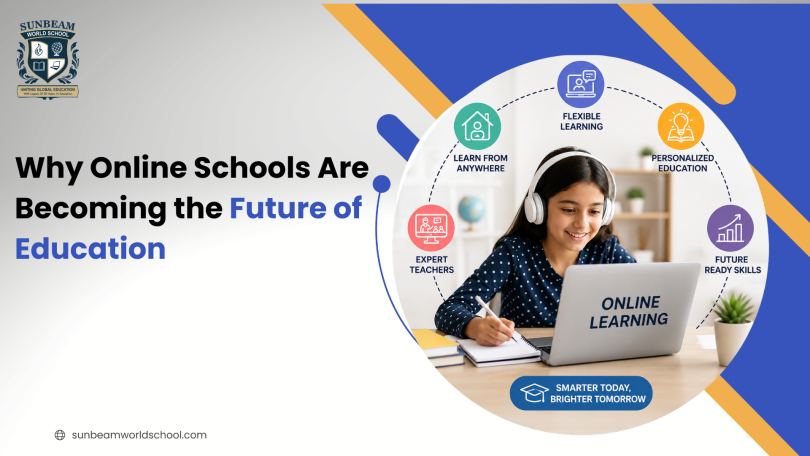

The classrooms are redefined, and not dismantled, but fundamentally reimagined. Across the globe, families are choosing online schooling for their children not as a last resort, but as a deliberate, informed decision
Schools like Sunbeam World School, Asia’s largest international online school with over 100,000 students across 30+ countries, are proof that this shift is no longer on the horizon; it is already here. What was once considered a niche alternative has become a mainstream educational model, and for good reason.
This shift is backed by data, driven by innovation, and validated by the growing number of students who are thriving in online learning environments. To understand why online schooling is becoming the future education, we need to look at what it offers that traditional schooling often cannot.
Learning That Adapts to the Student
One of the most significant limitations of traditional schooling is its one-size-fits-all structure. Thirty students in a room, one teacher, one pace. Some students are bored; others are struggling to keep up. Neither group is being served as well as they could be.
Online education solves this through personalized learning pathways. Students can progress through material at a pace that suits their individual needs, with teachers able to track exactly where each child is excelling or falling behind. AI-powered platforms take this even further, analyzing learning patterns in real time and helping educators make targeted interventions.
Schools like Sunbeam World School clearly demonstrate how technology and pedagogy can work together to make personalized education a practical reality.
Global Access to Internationally Recognized Curricula
Geography has historically been one of the greatest determinants of educational quality. A child born in a remote region, or in a country with under-resourced schools, had limited options regardless of their ability or ambition.
Online school disrupts this inequality directly. Students anywhere in the world can now access internationally accredited curricula — including CBSE-aligned programs, Cambridge (IGCSE and A-Level), Australian WACE pathways, and American standards — and earn qualifications recognized by universities globally.
This is particularly significant for:
- Expatriate families who relocate frequently and need curriculum continuity across countries
- Students in regions where local schooling options are limited or misaligned with global standards
- Families seeking specific pathways, such as Indian students preparing for competitive entrance exams alongside a Cambridge track
Flexibility Without Compromising Academic Rigor
A common concern among parents considering online schooling is whether flexibility comes at the cost of structure. The evidence suggests it does not—provided the school is well designed.
Quality online programs are built around live, teacher-led classes that foster real-time interaction, discussion, and accountability. Students attend scheduled sessions, submit assignments, sit examinations, and receive detailed academic feedback, just as they would in a physical school. The difference is that this happens within a framework that can accommodate a young athlete’s training schedule, a family living across time zones, or a student who simply learns better in a quieter environment.
The key distinction is between asynchronous programs (pre-recorded content with minimal teacher interaction) and synchronous programs (live classes with qualified teachers). The latter, when executed well, delivers academic rigor comparable to traditional schooling, with the added benefit of flexibility.
A Genuinely Global Learning Community
Perhaps the most underappreciated dimension of online K-12 education is its capacity to create diverse, international student communities. Rather than being surrounded exclusively by peers from the same neighborhood or city, students in global online schools interact daily with classmates from different countries, cultures, and perspectives.
This cross-cultural exposure is not incidental; it is one of the most valuable aspects of the model. Students develop a natural global awareness, practice communicating across cultural contexts, and build friendships that span continents. These are skills that no amount of classroom geography lessons can fully replicate.
Preparing Students for the World They Will Actually Inhabit
The workplace most of today’s students will enter is already digital. Remote collaboration, self-directed learning, comfort with technology, and the ability to communicate across geographies are not edge-case skills; they are foundational requirements across virtually every professional field.
Students educated in well-structured online environments arrive at higher education and their careers with these capabilities already developed. They are practiced at managing their own time, navigating digital tools, contributing to virtual teams, and sustaining focus without physical supervision. In a meaningful sense, online school does not just teach subjects; it teaches students how to function effectively in the modern world.
What to Look for in a Quality Online School
As the sector grows, so does the range of options available, and not all of them are equal. Parents researching online schooling for their children should look for:
- Live, teacher-led classes with qualified educators, not just pre-recorded content
- International accreditation and recognised certifications (check which universities accept the qualifications)
- A proven student support system — including academic counselling, pastoral care, and career guidance
- A transparent track record — where do graduates go? What are the academic outcomes?
- Reliable, secure technology and a platform built for sustained learning rather than occasional use
Schools with a long track record, genuine international reach, and documented student outcomes, such as Sunbeam World School’s network spanning 30+ countries with Nursery through Grade 12 programs, offer a useful benchmark for what quality in this space looks like.
Conclusion
Online education is no longer a contingency plan. It is a proven model with distinct advantages: genuine personalization, global access to quality curricula, flexibility that does not compromise rigor, and the kind of real-world skills that traditional schooling has long struggled to develop.
The question for families, educators, and policymakers is no longer whether online schooling can work. The evidence shows clearly that it can, and institutions like Sunbeam World School show exactly what it looks like when it works at its best.
The future of education is not purely online, nor purely offline. But online schooling has permanently earned its place at the center of that future, and the schools leading the way are already showing what is possible.