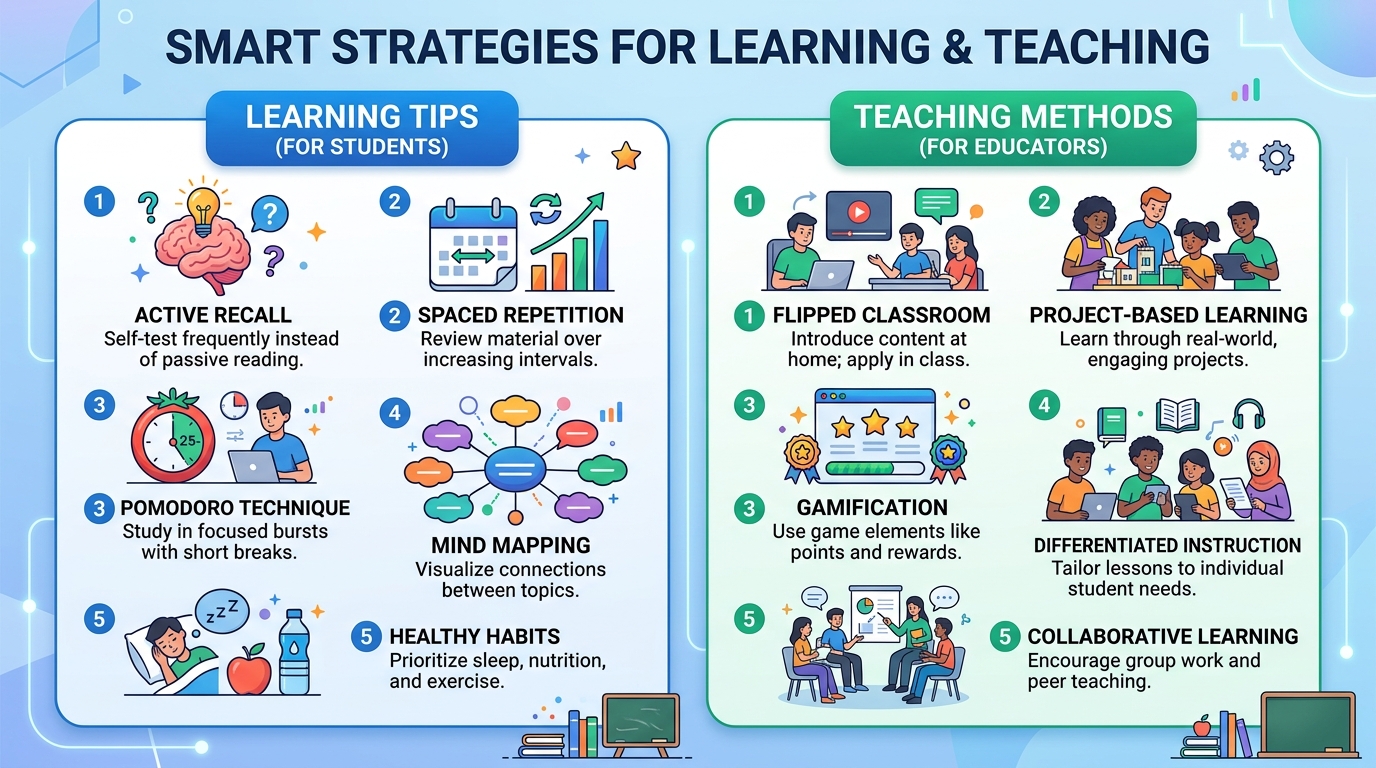
Students forget most of a lecture within days, no matter how clearly it was delivered. That uncomfortable fact has pushed educators toward active learning strategies: methods that make learners do something with new material instead of merely receiving it. The evidence is now overwhelming. Across hundreds of studies, students in active classrooms learn more, fail less, and retain knowledge longer than students taught by uninterrupted lecturing. Whether you teach a class, train a team, or learn alone, these methods can transform your results.
Start With a Problem, Not an Explanation
Most lessons begin with theory and end with application. Active learning strategies often reverse that order. Present a problem, scenario, or question first and let learners attempt it with what they already know. Their initial attempts — even wrong ones — activate prior knowledge and create a mental shelf where the coming explanation can land.
This works in self-study too. Before reading a chapter, attempt its exercises. Before watching a tutorial, try the task yourself for ten minutes. When learners exploring a new technical field ask where to begin with cybersecurity education, the strongest programmes answer with exactly this structure: small real problems first, theory introduced just in time to solve them.
Build In Retrieval Every Few Minutes
Attention decays quickly during passive listening, but a well-placed question resets it. Pause and ask learners to write down the key point from the last segment, answer a quick poll, or solve a one-minute problem. These micro-checks serve two purposes: they force retrieval, which strengthens memory, and they show the teacher exactly where understanding is breaking down while there is still time to repair it.
For solo learners, the equivalent is the blank-page test. Every twenty minutes, stop and write everything you remember about what you just studied, without looking. The gaps you reveal are your real study list.
Retrieval questions need to demand more than recognition. Multiple-choice formats that learners can guess their way through produce weak effects; questions that require generating an answer — a definition, a worked step, an explanation — produce strong ones. When you write your own checks, prefer prompts you must answer in full sentences. If you can mark your own answer as “close enough” without producing it, the question is doing the learning for you, and the learning is not happening.
Use Peer Teaching and Structured Discussion
Explaining an idea to another person is one of the most demanding cognitive tasks there is, which is why it teaches so effectively. Pair learners up and have each teach the other a concept, then switch. Discussion works best when it is structured: a specific question, a time limit, and an expected product such as a ranked list or a worked solution. Unstructured “discuss this topic” invitations usually produce one voice and several spectators.
Think-pair-share is the simplest reliable format — think silently, compare with a partner, then share with the group — and it scales from primary classrooms to corporate training. It is a staple of active learning strategies because it gives every learner, including the quiet ones, a low-risk first attempt before public answers.
Make Practice Look Like the Real Thing
Learners improve at what they practise, in the form they practise it. If the goal is solving problems, practise solving problems, not reading solutions. If the goal is professional judgement, practise with messy case studies rather than tidy textbook examples. Simulations, role plays, labs, and project work all count as active methods because they demand decisions, not just recall.
Practical realism matters online as well. Learners studying from home need working tools and connections, and small technical barriers can quietly kill participation; even something as mundane as working through common connection problems for new users before a course begins prevents the frustration that makes learners disengage in week one. Good teachers remove friction so effort goes into thinking, not troubleshooting.
Realism also means varied difficulty. Include stretch problems that a third of the class will fail on the first attempt, and normalise that failure as data rather than disgrace. Learners who only ever practise at a comfortable level plateau quickly, because nothing in the session tells them where their understanding ends. Deliberately sequenced challenge — manageable now, harder next week — is what turns participation into progress.
Give Feedback While It Can Still Change the Work
Feedback delivered after a final assessment is an autopsy. Feedback delivered during practice is coaching. Active learning strategies build in frequent, low-stakes checks — draft reviews, practice quizzes, worked-example comparisons — so learners can correct course while the work is still changeable. Keep the stakes low: when every attempt affects the grade, learners hide their confusion instead of exposing it.
Feedback should also point forward. “This paragraph asserts without evidence; add the data from the case study” gives the learner a next action. Vague praise and vague criticism both leave the learner exactly where they were.
Encourage learners to act on feedback visibly: revise the paragraph, rework the problem, re-record the presentation. The improvement between the first and second attempt is the most persuasive evidence a learner ever receives that effort changes outcomes — and it recalibrates how they hear criticism in future, as information rather than judgement. Teachers can accelerate this by occasionally returning to earlier work and asking learners to compare it with their current standard; the distance travelled is motivating in a way marks alone rarely are.
End With Consolidation, Not a Whimper
Close every session by making learners organise what they gained: a one-sentence summary, a concept map, an exit ticket answering “what is the most important idea and what is still unclear?” These closing minutes are when scattered activities consolidate into a structure the learner can carry away.
You do not need to adopt every method at once. Pick two or three active learning strategies — problem-first starts, frequent retrieval, structured peer teaching — and apply them consistently. Lessons stop being performances that wash over an audience and become workouts that build capability, and that is when learning starts to stick.