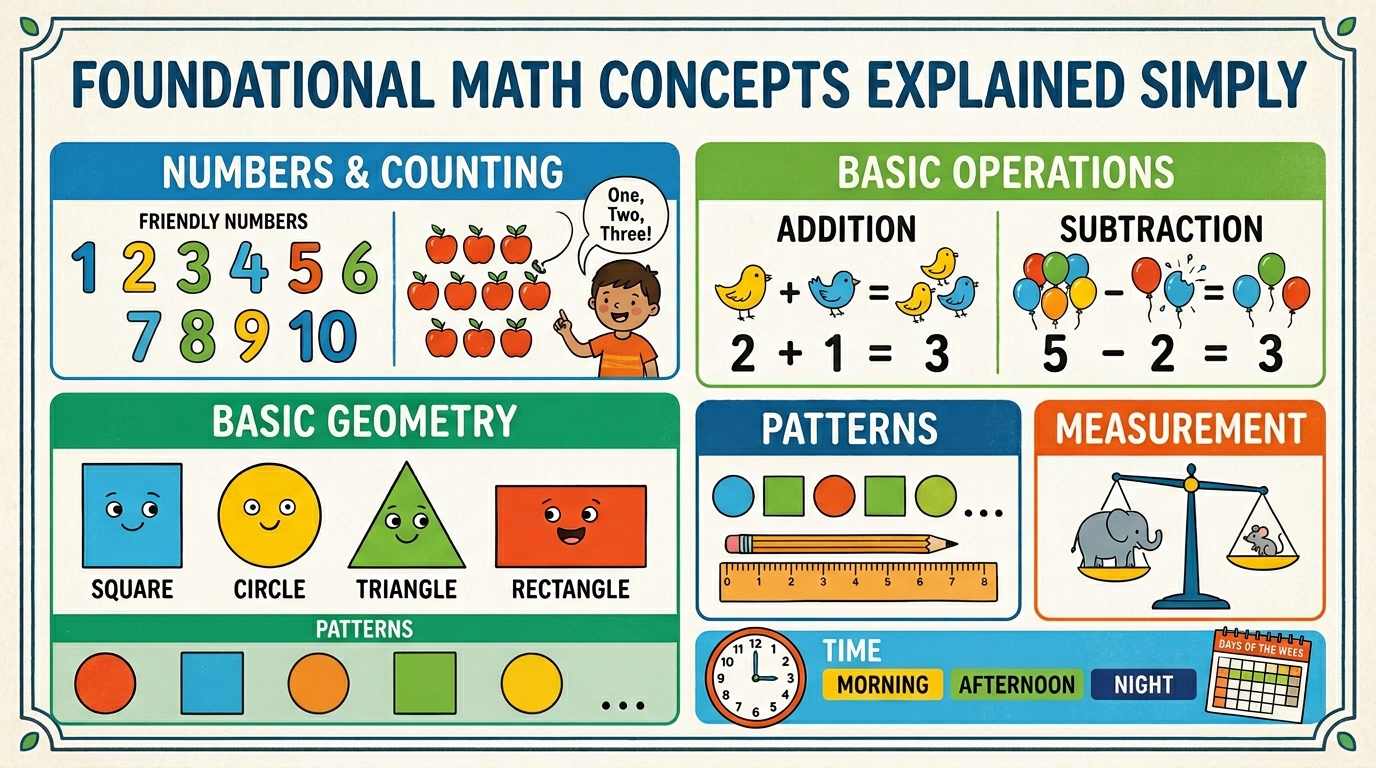

Foundational math concepts are the basic building blocks of mathematics that help learners understand more advanced topics later on. These include number systems, arithmetic operations, fractions, decimals, ratios, and simple equations. Without a strong understanding of these basics, it becomes difficult to solve complex problems in algebra, geometry, or higher-level math. Learning these concepts in a simple way helps students build confidence and improve problem-solving skills step by step.
Numbers and Number Systems
Numbers are the starting point of mathematics. They include natural numbers, whole numbers, integers, and rational numbers. Understanding how numbers work helps students perform calculations and recognize patterns in math problems.
Number systems also teach how values are organized and compared. This foundation is important because almost every math topic is based on how numbers interact with each other.
Basic Arithmetic Operations
Arithmetic operations include addition, subtraction, multiplication, and division. These are the most commonly used math skills in daily life and academic studies.
Mastering these operations helps students solve real-world problems such as budgeting, measuring, and calculating time. Strong arithmetic skills also make advanced math topics easier to understand.
Fractions, Decimals, and Percentages
Fractions represent parts of a whole, while decimals and percentages are different ways of expressing the same idea. These concepts are essential for understanding measurements, comparisons, and data analysis.
Learning how to convert between fractions, decimals, and percentages helps students solve problems more efficiently and understand mathematical relationships clearly.
Basic Algebra Concepts
Algebra introduces the idea of using symbols and letters to represent unknown values. Simple equations help students learn how to find missing numbers and solve problems logically.
This foundation is important because algebra is used in almost all advanced math topics. It helps develop logical thinking and problem-solving abilities.
Geometry Basics
Geometry focuses on shapes, sizes, and space. Basic concepts include points, lines, angles, triangles, and circles. These ideas help students understand how objects are structured in the real world.
Geometry is widely used in fields like engineering, architecture, and design. Learning these basics builds spatial awareness and visual understanding.
Frequently Asked Questions
What are foundational math concepts
They are basic math topics like numbers, operations, fractions, and algebra.
Why are they important
They form the base for learning advanced mathematics.
Is algebra a foundational concept
Yes, basic algebra is part of foundational math learning.
Can I learn math without basics
No, strong basics are needed to understand higher-level math.
How can I improve math fundamentals
Through regular practice and understanding core concepts step by step.
Conclusion
Foundational math concepts are essential for building strong mathematical skills. By understanding numbers, operations, fractions, algebra, and geometry, students can develop a solid base for advanced learning. Mastering these basics not only improves academic performance but also helps in solving real-life problems with confidence and accuracy.